Bidvertiser

Showing posts with label News. Show all posts

Monday, 24 June 2013

Sexual assault has emerged as one of the defining issues for the military this year.

In Debate Over Military Sexual Assault, Men Are Overlooked Victims

Daniel Acker for The New York Times
A scrapbook made by Gregory Helle, who says he was raped by another soldier in Vietnam.


Sexual assault has emerged as one of the defining issues for the military this year. Reports of assaults are up, as are questions about whether commanders have taken the problem seriously. Bills to toughen penalties and prosecution have been introduced in Congress
But in a debate that has focused largely on women, this fact is often overlooked: the majority of service members who are sexually assaulted each year are men.
In its latest report on sexual assault, the Pentagon estimated that 26,000 service members experienced unwanted sexual contact in 2012, up from 19,000 in 2010. Of those cases, the Pentagon says, 53 percent involved attacks on men, mostly by other men.
“It’s easy for some people to single out women and say: ‘There’s a small percentage of the force having this problem,’ ” said First Lt. Adam Cohen, who said he was raped by a superior officer. “No one wants to admit this problem affects everyone. Both genders, of all ranks. It’s a cultural problem.”
Though women, who represent about 15 percent of the force, are significantly more likely to be sexually assaulted in the military than men, experts say assaults against men have been vastly underreported. For that reason, the majority of formal complaints of military sexual assault have been filed by women, even though the majority of victims are thought to be men.
“Men don’t acknowledge being victims of sexual assault,” said Dr. Carol O’Brien, the chief of post-traumatic stress disorder programs at the Bay Pines Veterans Affairs Health Care System in Florida, which has a residential treatment program for sexually abused veterans. “Men tend to feel a great deal of shame, embarrassment and fear that others will respond negatively.”
But in recent months, intense efforts on Capitol Hill to curb military sexual assault, and the release of a new documentary about male sexual assault victims in the military, “Justice Denied,” have brought new attention to male victims. Advocates say their plight shows that sexual assault has risen not because there are more women in the ranks but because sexual violence is often tolerated.
“I think telling the story about male victims is the key to changing the culture of the military,” said Anuradha K. Bhagwati, executive director of the Service Women’s Action Network, an advocacy group that has sharply criticized the Pentagon’s handling of sexual assault. “I think it places the onus on the institution when people realize it’s also men who are victims.”
The Department of Defense says it is developing plans to encourage more men to report the crime. “A focus of our prevention efforts over the next several months is specifically geared towards male survivors and will include why male survivors report at much lower rates than female survivors, and determining the unique support and assistance male survivors need,” Cynthia O. Smith, a department spokeswoman, said in a statement.
In interviews, nearly a dozen current and former service members who said they were sexually assaulted in the military described fearing that they would be punished, ignored or ridiculed if they reported the attacks. Most said that before 2011, when the ban on openly gay service members was repealed, they believed they would have been discharged if they admitted having sexual contact — even unwanted contact — with other men.
“Back in 1969, you didn’t dare say a word,” said Gregory Helle, an author who says he was raped in his barracks by another soldier in Vietnam. “They wouldn’t have believed me. Homophobia was big back then.”
Thomas F. Drapac says he was raped on three occasions by higher-ranking enlisted sailors in Norfolk in 1966. He said he had been drinking each time and feared that if he told prosecutors they would assume it was consensual sex. Parts of his story are corroborated in Department of Veterans Affairs records. 

High-wire artist Nik Wallenda crosses Grand Canyon gorge - video

 High-wire artist Nik Wallenda has successfully completed a walk across the Little Colorado River gorge near the Grand Canyon in Arizona without a safety harness. One camera showed the view looking down to the river 1,500 feet (457 meters) below. Wallenda stepped slowly and steadily throughout the quarter of a mile walk, murmuring prayers along the way. He stopped twice during the 22 minute walk. The winds were higher than expected, and he said it took every bit of him to stay focused

Click The Link To Watch The Video: http://www.guardian.co.uk/world/video/2013/jun/24/high-wire-nik-wallenda-grand-canyon-gorge-video?CMP=twt_gu

DNA from a cave in Russia adds a mysterious new member to the human family.

National Geographic Magazine . Science
Picture of Russian cave Denisovan excavation

The Case of the Missing Ancestor

DNA from a cave in Russia adds a mysterious new member to the human family.

By Jamie Shreeve
Photograph by Robert Clark
In the Altay Mountains of southern Siberia, some 200 miles from where Russia touches Mongolia, China, and Kazakhstan, nestled under a rock face about 30 yards above a little river called the Anuy, there is a cave called Denisova. It has long attracted visitors. The name comes from that of a hermit, Denis, who is said to have lived there in the 18th century. Long before that, Neolithic and later Turkic pastoralists took shelter in the cave, gathering their herds around them to ride out the Siberian winters. Thanks to them, the archaeologists who work in Denisova today, surrounded by walls spattered with recent graffiti, had to dig through deep layers of goat dung to get to the deposits that interested them. But the cave’s main chamber has a high, arched ceiling with a hole near the top that directs shimmering shafts of sunlight into the interior, so that the space feels holy, like a church.
In the back of the cave is a small side chamber, and it was there that a young Russian archaeologist named Alexander Tsybankov was digging one day in July 2008, in deposits believed to be 30,000 to 50,000 years old, when he came upon a tiny piece of bone. It was hardly promising: a rough nubbin about the size and shape of a pebble you might shake out of your shoe. Later, after news of the place had spread, a paleoanthropologist I met at Denisova described the bone to me as the “most unspectacular fossil I’ve ever seen. It’s practically depressing.” Still, it was a bone. Tsybankov bagged it and put it in his pocket to show a paleontologist back at camp.
The bone preserved just enough anatomy for the paleontologist to identify it as a chip from a primate fingertip—specifically the part that faces the last joint in the pinkie. Since there is no evidence for primates other than humans in Siberia 30,000 to 50,000 years ago—no apes or monkeys—the fossil was presumably from some kind of human. Judging by the incompletely fused joint surface, the human in question had died young, perhaps as young as eight years old.
Anatoly Derevianko, leader of the Altay excavations and director of the Institute of Archaeology and Ethnography in Novosibirsk, thought the bone might belong to a member of our own species, Homo sapiens. Sophisticated artifacts that could only be the work of modern humans, including a beautiful bracelet of polished green stone, had previously been found in the same deposits. But DNA from a fossil found earlier in a nearby cave had proved to be Neanderthal, so it was possible this bone was Neanderthal as well.
Derevianko decided to cut the bone in two. He sent one half to a genetics laboratory in California; so far he has not heard from that half again. He slipped the other half into an envelope and had it hand-delivered to Svante Pääbo, an evolutionary geneticist at the Max Planck Institute for Evolutionary Anthropology in Leipzig, Germany. It was there that the case of the Denisovan pinkie bone took a startling turn.
Pääbo, a transplanted Swede, is arguably the world’s leading expert in ancient DNA, especially human DNA. His milestones are many. In 1984 he became the first person to isolate DNA from an Egyptian mummy. In 1997 he accomplished the same feat for the first time with a Neanderthal, a kind of human that vanished more than 25,000 years before the Egyptian pharaohs. That secured his scientific reputation.
When Pääbo received the package from Derevianko, his team was hard at work producing the first sequence of the entire Neanderthal genome—another feat that had once seemed impossible and that was occupying most of his attention. His lab also had a backlog of other fossils to test from all parts of the globe. So it wasn’t until late 2009 that the little Russian finger bone drew the attention of Johannes Krause, at the time a senior member of Pääbo’s team. (He’s now at the University of Tübingen.) Like everyone else, Krause assumed the bone was from an early modern human. He had developed a method for distinguishing the DNA of such a fossil from that of the archaeologists, museum workers, and anyone else who might have handled and therefore contaminated it.
Krause and his student Qiaomei Fu extracted the finger bone’s mitochondrial DNA (mtDNA), a small bit of the genome that living cells have hundreds of copies of and that is therefore easier to find in ancient bone. They compared the DNA sequence with those of living humans and Neanderthals. Then they repeated the analysis, because they couldn’t believe the results they’d gotten the first time around.
On a Friday afternoon, with Pääbo away at a meeting at Cold Spring Harbor Laboratory on Long Island, Krause called a meeting of the lab staff and challenged anyone to come up with a different explanation for what he was seeing. No one could. Then he dialed Pääbo’s cell. “Johannes asked me if I was sitting down,” Pääbo remembers. “I said I wasn’t, and he replied that I had better find a chair.”
Krause himself recalls that Friday as “scientifically the most exciting day of my life.” The tiny chip of a finger bone, it seemed, was not from a modern human at all. But it wasn’t from a Neanderthal either. It belonged to a new kind of human being, never before seen.
In July 2011, three years after Tsybankov unearthed the bone chip, Anatoly Derevianko organized a scientific symposium at the archaeological camp a few hundred yards from Denisova cave. At an opening night dinner punctuated with frequent toasts of vodka, Derevianko welcomed the 50 researchers, including Pääbo, who had come to see the cave and share their views on how the mysterious new human fit into the fossil and archaeological record for human evolution in Asia.
The year before, two other fossils had been found to contain DNA similar to that of the finger bone, both of them molars. The first tooth had turned up among the specimens from Denisova housed at Derevianko’s institute in Novosibirsk. It was bigger than either a modern human or a Neanderthal tooth, in size and shape resembling the teeth of much more primitive members of the genus Homo who lived in Africa millions of years ago. The second molar had been found in 2010 in the same cave chamber that had yielded the finger bone—indeed, near the bottom of the same 30,000-to-50,000-year-old deposits, called Layer 11.
Remarkably, that tooth was even bigger than the first, with a chewing surface twice that of a typical human molar. It was so large that Max Planck paleoanthropologist Bence Viola mistook it for a cave bear tooth. Only when its DNA was tested was it confirmed to be human—specifically, Denisovan, as the scientists had taken to calling the new ancestors. “It shows you how weird these guys are,” Viola told me at the symposium. “At least their teeth are just very strange.”
Pääbo’s team could extract only a tiny amount of DNA from the teeth—just enough to prove they came from the same population as the finger, though not from the same individual. But the finger bone had been spectacularly generous.
DNA degrades over time, so usually very little remains in a bone tens of thousands of years old. Moreover, the DNA from the bone itself—called endogenous DNA—is typically just a tiny fraction of the total DNA in a specimen, most of which comes from soil bacteria and other contaminants. None of the Neanderthal fossils Pääbo and his colleagues had ever tested contained even 5 percent endogenous DNA, and most had less than one percent. To their amazement, the DNA in the finger bone was some 70 percent endogenous. Apparently, the cold cave had preserved it well.
Given so much DNA, the scientists easily ascertained that there was no sign of a male Y chromosome in the specimen. The fingertip had belonged to a little girl who had died in or near Denisova cave tens of thousands of years before. The scientists had no idea, at first, what she looked like—just that she was radically different from anything else they had ever seen.
For a while they thought they might have her toe too. In the summer of 2010 a human toe bone had emerged, along with the enormous tooth, from Layer 11. In Leipzig a graduate student named Susanna Sawyer analyzed its DNA. At the symposium in 2011 she presented her results for the first time. To everyone’s shock, the toe bone had turned out to be Neanderthal, deepening the mystery of the place.
The green stone bracelet found earlier in Layer 11 had almost surely been made by modern humans. The toe bone was Neanderthal. And the finger bone was something else entirely. One cave, three kinds of human being. “Denisova is magical,” said Pääbo. “It’s the one spot on Earth that we know of where Neanderthals, Denisovans, and modern humans all lived.” All week, during breaks in the conference, he kept returning alone to the cave. It was as if he thought he might find clues by standing where the little girl may have stood and touching the cool stone walls she too may have touched.
Pääbo grew up in Stockholm with his single mother, a chemist, and on certain days with his father, a biochemist named Sune Bergström, who had another, legitimate family and would later win a Nobel Prize. Pääbo’s own first passion was Egyptology, but he switched to molecular biology, then fused the two interests in 1984 with his work on mummy DNA. Once anchored in the study of the past, he never let go. He is 58 now, tall and lanky, with large ears, a long, narrow head, and pronounced eyebrows that arch up and down animatedly when he’s excited—about Denisova, for instance.
How had all three kinds of human ended up there? How were Neanderthals and Denisovans related to each other and to the sole kind of human that inhabits the planet today? Did their ancestors have sex with ours? Pääbo had a history with that kind of question.
The Neanderthal DNA he had made headlines with in 1997 was utterly different from that of any person now alive on Earth. It seemed to suggest that Neanderthals had been a separate species from us that had gone extinct—suspiciously soon after our ancestors first migrated out of Africa into the Neanderthals’ range in western Asia and Europe. But that DNA, like Krause’s first extract from the Denisovan finger, was mtDNA: It came from the mitochondria, the energy-producing organelles inside the cell, and not from the cell nucleus, where the vast bulk of our genome resides. Mitochondrial DNA includes only 37 genes, and it’s inherited only from the mother. It’s a limited record of a population’s history, like a single page torn from a book.
By the time of the Denisova symposium, Pääbo and his colleagues had published first drafts of the entire Neanderthal and Denisovan genomes. Reading so many more pages allowed Pääbo and his colleagues, including David Reich at Harvard University and Montgomery Slatkin at the University of California, Berkeley, to discover that human genomes today actually contain a small but significant amount of Neanderthal code—on average about 2.5 percent. The Neanderthals still may have been swept into extinction by the strange, high-browed new people who followed them out of Africa, but not before some commingling that left a little Neanderthal in most of us, 50,000 years later. Only one group of modern humans escaped that influence: Africans, because the commingling happened outside that continent.
Although the Denisovans’ genome showed that they were more closely related to the Neanderthals, they too had left their mark on us. But the geographic pattern of that legacy was odd. When the researchers compared the Denisovan genome with those of various modern human populations, they found no trace of it in Russia or nearby China, or anywhere else, for that matter—except in the genomes of New Guineans, other people from islands in Melanesia, and Australian Aborigines. On average their genomes are about 5 percent Denisovan. Negritos in the Philippines have as much as 2.5 percent.
Putting all the data together, Pääbo and his colleagues came up with a scenario to explain what might have occurred. Sometime before 500,000 years ago, probably in Africa, the ancestors of modern humans split off from the lineage that would give rise to Neanderthals and Denisovans. (The most likely progenitor of all three types was a species called Homo heidelbergensis.) While our ancestors stayed in Africa, the common ancestor of Neanderthals and Denisovans migrated out. Those two lineages later diverged, with the Neanderthals initially moving west into Europe and the Denisovans spreading east, perhaps eventually populating large parts of the Asian continent.
Later still, when modern humans ventured out of Africa themselves, they encountered Neanderthals in the Middle East and Central Asia, and to a limited extent interbred with them. According to evidence presented by David Reich at the Denisova symposium, this mixing most likely occurred between 67,000 and 46,000 years ago. One population of modern humans then continued east into Southeast Asia, where, sometime around 40,000 years ago, they encountered Denisovans. The moderns interbred with them as well and then moved into Australasia, carrying Denisovan DNA.
This scenario might explain why the only evidence so far that the Denisovans even existed is three fossils from a cave in Siberia and a 5 percent stake in the genomes of people living today thousands of miles to the southeast. But it left a lot of questions unanswered. If the Denisovans were so widespread, why was there no trace of them in the genomes of Han Chinese or of any other Asian people between Siberia and Melanesia? Why had they left no mark in the archaeological record—no distinctive tools, say? Who were they really? What did they look like? “Clearly we need much more work,” Pääbo acknowledged at the Denisova symposium.
The best of all possible developments would be to find Denisovan DNA in a skull or other fossil with distinctive morphological features, one that could serve as a Rosetta stone for reexamining the whole fossil record of Asia. There are some intriguing candidates, most from China, and three skulls in particular, dated between 250,000 and 100,000 years ago. Pääbo is working closely with scientists at the Institute of Vertebrate Paleontology and Paleoanthropology in Beijing and has set up a DNA testing lab there. Unfortunately DNA does not preserve well in warmer climates. To date, no other fossil has been identified as Denisovan by the only way Denisovans can be known: their DNA.
In 2012 Pääbo’s group published a new version of the finger bone’s genome—astonishingly, one that in accuracy and completeness rivals any living human’s genome that has been sequenced. The breakthrough came from a German postdoc in Pääbo’s lab named Matthias Meyer. DNA consists of two interlocking strands—the familiar double helix. Previous methods for retrieving DNA from fossil bone could read out sequences only when both strands were preserved. Meyer had developed a technique for recovering short, single-stranded fragments of DNA as well, greatly increasing the amount of raw material to work with. The method produced a version of the Denisovan girl’s genome so precise that the team could discriminate between genetic information inherited from her mother and that from her father. In effect, they now had two highly accurate Denisovan genomes, one from each parent. These in turn opened a window on the entire history of their population.
One immediate revelation was how little variation there was between the parents’ genomes—about a third as much as there is between any two living humans. The differences were sprinkled across the genomes, which ruled out inbreeding: If the girl’s parents had simply been closely related, they would have had huge chunks of exactly matched DNA. The pattern indicated instead that the Denisovan population represented by the fossil had never been large enough to have developed much genetic diversity. Worse, it seemed to have suffered a drastic decline sometime before 125,000 years ago—the little girl in the cave may have been among the last of her kind.
Meanwhile the ancestral population of modern humans was expanding. Myriad fossils, libraries full of books, and the DNA of seven billion people are available to document our subsequent population history. Pääbo’s team discovered a completely different one inside a single bone chip. The thought tickles him. “It’s incredibly cool that there is no one walking around today with a population history like that,” Pääbo told me, his eyebrows shooting up.
And yet the Denisovans also have something to say about our own kind. With virtually every letter of the Denisovan genetic code in hand, Pääbo and his colleagues were able to take aim at one of the profoundest mysteries: In our own genomes, what is it that makes us us? What defining changes in the genetic code took place after we separated from our most recent ancestor? Looking at the places where all living humans share a novel genetic signature but the Denisovan genome retains a primitive, more apelike pattern, the researchers came up with a surprisingly short list. Pääbo has called it the “genetic recipe for being a modern human.” The list includes just 25 changes that would alter the function of a particular protein.
Intriguingly, five of these proteins are known to affect brain function and development of the nervous system. Among them are two genes where mutations have been implicated in autism and another that’s involved in language and speech. Just what those genes actually do to make us think, act, or talk differently than Denisovans, or any other creature that has walked the Earth, remains to be seen. The lasting contribution of studying Denisovan DNA, Pääbo says, “will be in finding what is exclusively human.”
But what of the little girl herself? The tiny bit of bone that is all we ever had of her—or at least the half that went to Leipzig—is gone now. In pulling DNA from it, Johannes Krause and Qiaomei Fu eventually used it all up. The little girl has been reduced to a “library” of DNA fragments that can be exactly copied again and again forever. In the scientific paper discussing the history of her population, Pääbo and his colleagues did mention, almost in passing, a few facts about her that they had gleaned from that library: She probably had dark hair, dark eyes, and dark skin. It isn’t much, but at least it sketches in broad strokes what she looked like. Just so we know whom to thank.
Read more: http://ngm.nationalgeographic.com/2013/07/125-missing-human-ancestor/shreeve-text

Ancient Egyptian God of death statue starts SPINNING on its own in Manchester museum...

Mail . Online

The turn of the mummy: God of death statue starts SPINNING on its own in Manchester museum... but is this a sign that there really is a curse of the Pharaohs?

  • 10-inch tall relic is an offering to Egyptian God Osiris, God of the dead
  • It has been filmed on a time lapse, seemingly spinning 180 degrees
  • TV physicist Brian Cox among the experts being consulted on mystery
  • But some now believe there could be 'spiritual explanation' for turning statue
By David Wilkes
|


THE curse of Tutankhamen is said to have claimed more than 20 lives. By contrast, the curse of Neb-Senu amounts to little more than an occasional inconvenience for museum curators.
Over several days, the ten-inch Egyptian statuette gradually rotates to face the rear of the locked glass cabinet in which it is displayed, and has to be turned around again by hand.
Those who like tales of haunted pyramids and walking mummies may regard the mystery of the 4,000-year-old relic – an offering to Osiris, god of the dead – as the strangest thing to hit Egyptology in decades.
Scroll down for video
Egyptologist Campbell Price studies an ancient Egyptian statuette at the Manchester Museum, which appears to be moving on its own
Others, including TV physicist Professor Brian Cox, have a more down-to-earth explanation for its movement.
Whatever the solution, the puzzle certainly won’t dent visitor numbers at its present home, Manchester Museum.
The statuette’s slow about-turn has been captured on film by a time-lapse camera, and curator Campbell Price, 29, says he believes there may be a spiritual explanation.
‘I noticed one day that it had turned around,’ he said. ‘I thought it was strange because it is in a case and I am the only one who has a key.

Sunday, 23 June 2013

What Gifts Does the Friends Of the President Obama Can Get

NPR. Politics

Presents From The President: What Obama Gives His Friends

Paula Deen Fired: Food Network Cancels Show After Racism Scandal

By RUSS BYNUM 06/21/13 05:45 PM ET EDT

Paula Deen
SAVANNAH, Ga. — The Food Network said Friday it's dumping Paula Deen, barely an hour after the celebrity cook posted the first of two videotaped apologies online begging forgiveness from fans and critics troubled by her admission to having used racial slurs in the past.
The 66-year-old Savannah kitchen celebrity has been swamped in controversy since court documents filed this week revealed Deen told an attorney questioning her under oath last month that she has used the N-word. "Yes, of course," Deen said, though she added, "It's been a very long time."
The Food Network, which made Deen a star with "Paula's Home Cooking" in 2002 and later "Paula's Home Cooking" in 2008, weighed in with a terse statement Friday afternoon.
"Food Network will not renew Paula Deen's contract when it expires at the end of this month," the statement said. Network representatives declined further comment. A representative for Deen did not immediately return phone and email messages seeking comment on the decision.
The news came as Deen worked to repair the damage to her image, which has spawned a vast empire of cookbooks, a bimonthly cooking magazine, a full line of cookware, food items like spices and even furniture.
She abruptly canceled a scheduled interview on NBC's "Today" show Friday morning, instead opting for a direct appeal via online video – one that allowed her and her staff complete control of what she said and how she said it.
"Inappropriate, hurtful language is totally, totally unacceptable," Deen said in the first 45-second video posted on YouTube. "I've made plenty of mistakes along the way but I beg you, my children, my team, my fans, my partners - I beg for your forgiveness."
Deen adopted a solemn tone as she looked straight into the camera. Still, her recorded apology featured three obvious edits – with the picture quickly fading out between splices – during a statement just five sentences long.
It was soon scrapped and replaced with a second video of Deen talking unedited for nearly two minutes as she insists: "Your color of your skin, your religion, your sexual preference does not matter to me."
""I want people to understand that my family and I are not the kind of people that the press is wanting to say we are," Deen says in the later video. "The pain has been tremendous that I have caused to myself and to others."
Deen never mentions Food Network or its decision to drop her in either of her online videos.
Deen initially planned to give her first interview on the controversy Friday to the "Today" show, which promoted her scheduled appearance as a live exclusive. Instead, host Matt Lauer ended up telling viewers that Deen's representatives pulled the plug because she was exhausted after her flight to New York. Deen said in her video she was "physically not able" to appear.
Court records show Deen sat down for a deposition May 17 in a discrimination lawsuit filed last year by a former employee who managed Uncle Bubba's Seafood and Oyster House, a Savannah restaurant owned by Deen and her brother, Bubba Hiers. The ex-employee, Lisa Jackson, says she was sexually harassed and worked in a hostile environment rife with innuendo and racial slurs.
During the deposition, Deen was peppered with questions about her racial attitudes. At one point she's asked if she thinks jokes using the N-word are "mean." Deen says jokes often target minority groups and "I can't, myself, determine what offends another person."
Deen also acknowledged she briefly considered hiring all black waiters for her brother's 2007 wedding, an idea inspired by the staff at a restaurant she had visited with her husband. She insisted she quickly dismissed the idea.
But she also insisted she and her brother have no tolerance for bigotry.
"Bubba and I, neither one of us, care what the color of your skin is" or what gender a person is, Deen said. "It's what's in your heart and in your head that matters to us."
 Read More: http://www.huffingtonpost.com/2013/06/21/paula-deen-fired-food-network-cancels-show-after-racism-scandal_n_3480517.html

Supermoon rises behind the Home Place clock tower in Prattville, Ala., Saturday.

A New Equation Reveals Our Exact Odds of Finding Alien Life

George Dvorsky Friday 11:00am
A New Equation Reveals Our Exact Odds of Finding Alien Life
It’s been over half a century since Frank Drake developed an equation to estimate the probability of finding intelligent life in our galaxy. We’ve learned a lot since then, prompting an astrophysicist from MIT to come up with her own take on the equation. Here’s how the new formula works — and how it could help in the search for alien life.
The new formula was devised by Sara Seager, a professor of planetary science and physics at the Massachusetts Institute of Technology. I contacted her to learn more about the new equation and why the time was right for a rethink.

Assessing the Probability of Intelligent Life

Back in 1961, Frank Drake proposed a probabilistic formula to help estimate the number of active, radio-capable extraterrestrial civilizations in the Milky Way Galaxy. It goes like this:

Edward Snowden, who has left Hong Kong on a plane to Moscow

The Guardian. NSA

Edward Snowden leaves Hong Kong for Moscow: live updates

Edward Snowden
Edward Snowden, who has left Hong Kong on a plane to Moscow. Photograph: AP

Birgitta Jónsdóttir, an Icelandic MP and internet freedom activist, has written a handy guide as to the obstacles facing Snowden if he opted to head for her country (which was mooted but now seems unlikely). Essentially, she warns, Snowden would not be safe unless the government granted him citizenship, as it did to the chess player Bobby Fischer when he faced US punishment for breaking a sporting embargo on the then-Yugosalvia.
Seeking political asylum is a process that can take long time, and there are no guarantees granted against extradition while the process is ongoing. However, since Snowden faces possible death sentence his case is stronger, for it is illegal to extradite a person who faces death sentence from Iceland. It is important to note that Iceland has a terrible track record when it comes to granting political asylum to people seeking shelter, as it is hardly never granted and thus a too dangerous path to be recommended for Snowden...
It is important to note that there has not been any formal requests for asylum from Snowden to the Icelandic government and thus impossible for them to respond with affirmative answer until such a request has been received.
China's foreign ministry has responded to today's news, both about Snowden's departure and the further allegations about US surveillance in China.
On Snowden's departure from Hong Kong:
We have noted relevant reports but are not aware of the specifics. We will continue to follow its development. Hong Kong is ruled by law. On the basis of the Basic Law of the Hong Kong Special Administrative Region and the principle of "one country, two systems", the central government always respects the HKSAR government's handling of affairs in accordance with law.
On the hacking allegations:
We are gravely concerned about the recently disclosed cyber attacks by relevant US government agencies against China. It shows once again that China falls victim to cyber attacks. We have made representations with the US.
Updated


Friday, 21 June 2013

Kedarnath in debris, thousands of pilgrims remain stranded

Times Of India
PTI Jun 19, 2013, 09.21PM IST
(The Kedarnath Temple. )
DEHRADUN/NEW DELHI: Uttarakhand chief minister Vijay Bahuguna on Wednesday said it would be difficult for the Kedarnath Yatra to be resumed for a year.
"I don't think we can resume the yatra there for one year. 18km of road has been damaged. Kedarnath is in debris. The temple has been saved but there is eight to ten feet of debris all around," he told
The chief minister said until the road is constructed, the debris cannot be removed. "We need machines, cooperation of the Army, Air Force. So, it is a problem of large magnitude. The state government and the central government together are doing their best," he said.
Bahuguna said if the weather is favourable in the coming days, then things will improve.
Over 10,000 personnel of the armed forces, 18 helicopters and a transport plane of the Air Force have been deployed for relief and rescue operations in the state where thousands have been stranded at tourist spots and pilgrim centres.
Toll rises to 150
The terrible magnitude of nature's fury in Uttarakhand unfolded as the death toll rose to 150 with fears that it may go up substantially as large parts remained under water while hundreds of houses and buildings lay in ruins.
After an aerial survey of the affected areas, Prime Minister Manmohan Singh announced a Rs 1,000 crore aid to the state where large-scale devastation has occurred.
Skies cleared today enabling stepping up of rescue and relief operations but the efforts were hampered by the vast destruction of the roads caused by landslips and flash floods that damaged hundreds of houses, buildings, hotels and government guest houses.
Several thousand pilgrims from across the country are still stranded in the state as reports came that the Kedarnath temple, one of the four holy dhams, was intact but the temple complex and the Rambada area around it have suffered total destruction.
"Very heavy casualties are feared and I cannot give the exact number without a proper survey," said Uttarakhand chief minister Vijay Bahuguna who described the flood ravage as unprecedented caused by a "Himalayan tsunami".
Singh and Congress President made an aerial survey of the affected areas and described what they saw as "most distressing".
He announced Rs 1,000 crore aid for the state for disaster relief of which Rs 145 crore is being released immediately.
"I have also directed all Central agencies to render all possible assistance in their domain to the state," he told reporters on his return.
PM announces Rs 1,000 crore relief
Prime Minister Manmohan Singh announced Rs 1,000 crore for disaster relief measures in flood-devastated parts of Uttarakhand where 102 persons have been killed and thousands left stranded at tourist spots and pilgrim centres.
Singh, who undertook an aerial survey of rain-ravaged Uttarakhand alongwith UPA chairperson Sonia Gandhi, said what they saw was "most distressing" and the priority for the authorities was to rescue the stranded and provide succour to those most in need of it.
Over 10,000 personnel of the armed forces, 18 helicopters and a transport plane of the Air Force have been deployed for relief and rescue operations in the state where thousands have been stranded at tourist spots and pilgrim centres.
"What chairperson UPA and I saw today was most distressing. While the most recent estimates put the death toll at 102, it is feared that loss of lives could eventually be much higher," Singh told reporters here.
He said more than 10,000 people have been rescued and were being provided food, clothing and shelter.
"Many persons still remain stranded. The maximum damage has been in Kedarnath and its vicinity," he said.
"I have decided to provide an amount of Rs 1000 crore to Uttarakhand for disaster relief, of which Rs 145 crore is being released immediately," Singh said after a meeting with state chief minister Vijay Bahuguna.
Singh said he has also directed all Central Agencies to render all possible assistance in their domain to the State.
The PM announced ex gratia assistance of Rs two lakh each to the families of those who have lost their lives and Rs 50,000 each to those injured.
In addition, ex gratia assistance of Rs one lakh each would also be provided to those whose houses have been completely destroyed and Rs 50,000 each to those whose houses have been damaged. Read More:  http://articles.timesofindia.indiatimes.com/2013-06-19/india/40068749_1_vijay-bahuguna-tourist-spots-aerial-survey

Aaron Hernandez Arrest Warrant Prepared on Obstruction of Justice Charge, Sources Say

ABC News

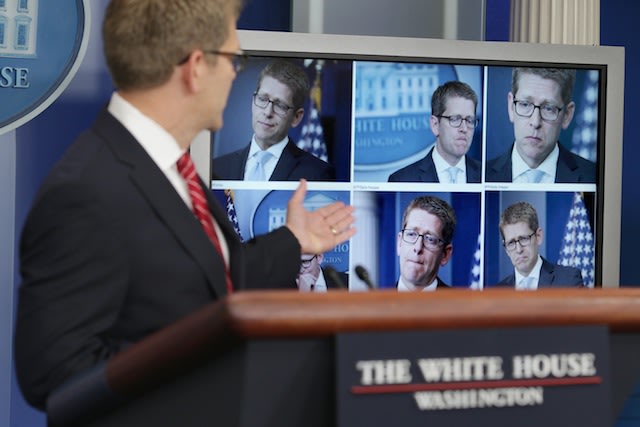
A Yahoo News analysis of the 444 briefings that Carney has held since becoming White House press secretary has identified 13 distinct strains in the way he dodges a reporter's question

Yahoo News

The top 9,486 ways Jay Carney won’t answer your questions (interactive)
White House Press Secretary Jay Carney. (Chip Somodevilla/Getty Images)
Jay Carney doesn’t have an answer for that. He hasn’t discussed that subject with the president. He will refer you to the Department of [insert agency here]. He refuses to speculate on that. He’ll have to get back to you.
But he appreciates the question.
A Yahoo News analysis of the 444 briefings that Carney has held since becoming White House press secretary has identified 13 distinct strains in the way he dodges a reporter's question. Since Carney held his first daily briefing with reporters in the White House Brady Press Briefing Room on Feb. 16, 2011, for example, he’s used some variation of "I don’t have the answer" more than 1,900 times. In 1,383 cases he referred a question to someone else. But will he at least speculate on hypotheticals? No. In fact, he has refused to do so 525 times.
In the following interactive, you can browse all 9,486 of Carney’s most-used responses and verbal crutches.
The main function of a White House press secretary is to shape messaging for the administration, which often requires stymieing questions as a form of damage control. The referral to another agency or person is one of Carney's favorite evasive maneuvers. Over the course of the 43-minute briefing on Jan. 25 alone, for example, Carney referred reporters to the Justice Department four times, the National Labor Relations Board twice, the State Department twice, once to the historic precedent of recess appointments, once to a New York Times article, once to a speech that President Barack Obama delivered earlier in the week, and once to the Defense Department.
As should be abundantly clear, Carney doesn't have all the answers. As he recently reminded the gathered reporters at his briefing, he and his team are mere mortals battling an army of professionals bent on stumping him.
"We have a team here that works really hard trying to anticipate the questions you're going to ask. The problem is, there's a lot of you and you're good at your jobs and you're smart. And we almost invariably do not anticipate every question that you ask. So sometimes we don’t have the answers, and sometimes we need to go back and get them," Carney said during the May 22 briefing.
That was a rare moment of effusive praise for the press. It followed what had been a rough series of briefings for Carney amid controversy over the 2012 attack in Benghazi, Libya, the Internal Revenue Service scandal and the Justice Department's secret seizure of journalists' phone records.
Those stories put Carney in a tougher-than-usual spot to speak for Obama and the White House, share information and shape the president's message, all without creating new controversy as he stood behind the podium.
More often than not, the imperative to do no harm prompts a total nonanswer from Carney. This results in the "I have no personnel announcements" for you today, referrals to other individuals and other gems that the press readily anticipates and often mocks.
Carney's recent predilection for saying "I appreciate the question," upon hearing a question he very likely did not appreciate, even prompted Politico to release a video montage May 14 of all those responses.
With good humor, Carney acknowledged it the next day.
"You know it’s a personal question, but a great question," Carney told CBS News White House Correspondent Mark Knoller, who asked whether Carney personally dreaded the briefings amid the controversies. "Do you appreciate it?" Knoller added, prompting laughter in the room.
"You beat me to my punch line," Carney said.
Read More: http://news.yahoo.com/blogs/ticket/top-9-486-ways-jay-carney-won-t-104907191.html 

Tuesday, 18 June 2013

No sign of Jimmy Hoffa remains so far


USA TODAY

FBI investigators find no remains in search after morning of excavating vacant field.

DETROIT -- Despite the help from forensic anthropologists and a police K-9, the search for the body of missing Teamster Jimmy Hoffa has so far turned up nothing, according to investigators.
A source at the scene said digging has taken place on about a half-acre of the grassy, vacant field on Buell Road in Oakland Township.
Read more: http://www.usatoday.com/story/news/nation/2013/06/18/jimmy-hoffas-remains-search-resumes/2433669/

1-Billion-Year-Old-Water Tastes 'Terrible'

The Atlantic Nature

Confirmed: 1-Billion-Year-Old Water Tastes 'Terrible'

Saltier than sea water and the consistency of "very light maple syrup." Yuck.

Controversial news of the National Security Agency's top secret PRISM program has now raised major privacy concerns for Americans.

Globalpost

7 graphs that prove America is overrated

Welcome to the Land of the Not-So-Free.
 
As if the recent string of high-profile scandals over Benghazi, AP phone records and the IRS weren't enough to land the Obama administration in political hot water, the controversial news of the National Security Agency's top secret PRISM program has now raised major privacy concerns for Americans.
While civil liberties continue to face erosion by heightened security and surveillance programs, there are many other areas where the American reality doesn't match the hype. Here are seven metrics that show US citizens' quality of life isn't as high as many imagine:

Peekaboo, I see you


Source: Privacy International
The US is the second worst country in the democratic world for overall privacy protection, though the UK grabbed the top spot, according to Privacy International. The two Western powers — along with Malaysia, Russia and China — were said to have "endemic" surveillance with few safeguards.


Baby drama


Source: ThinkProgress
The US is the only Organisation for Economic Cooperation and Development (OECD) member-country that doesn't require paid maternity leave. And comparing it to the rest of the world doesn't make the situation look much better: the US is one of only four countries that doesn't have official paid leave for parents, joined by Liberia, Sierra Leone and Papua New Guinea.


America is unusually violent


Source: Kieran Healy/OECD
Once again, the US is an outlier, but for all the wrong reasons. Sociologist Kieran Healy made this chart comparing deaths in the US by assault (gun violence, stabbings, etc.) with other OECD countries since the 1960s. 


Costly health care


Source: OECD
The US spends more than any other country on health care, costing every American an average of $8,000 and the government $4,000 per person, annually. Why is health care in America so expensive? Primarily due to the price of medical goods and services, as well as financial waste, according to nonprofit medical company The Regence Group.

 Gas guzzlers


Source: World Data Bank
More than a billion cars were motoring around the world in 2010, a full quarter of them in the US — the largest contribution of any country in the world. The graph above shows that the US has consistently produced double the amount of CO2 emissions (metric tons per capita) compared to the average amount produced by the rest of the OECD.


Vacation Shmaycation


Source: The Unemployment Law Project
There is no federal law mandating paid vacation for American workers, meaning that even if you're lucky enough to receive paid leave, your employer isn't required to provide it. One in four US workers doesn't receive any paid time off.

Glass ceiling


Source: World Data Bank
More from GlobalPost: Inside the United States: GlobalPost goes inside the United States to uncover the regime’s dramatic descent into authoritarian rule and how the opposition plans to fight back.
The lack of female representation in positions of power has long been a topic in the US and elsewhere, but the numbers show America is lagging behind. We offer this poignant 2011 excerpt about women in Congress from Jennifer Steinhauer of The New York Times:
"Even as women have made strides in many areas of political life, Congress remains male dominated. From the galleries above, the Senate and House floors often appear to be a sea of red and blue ties, with the occasional mid-calf red skirt suit floating among them. Until just a few months ago, there wasn’t even a women’s restroom near the House floor."
 Read More: http://www.globalpost.com/dispatch/news/regions/americas/united-states/130607/7-graphs-america-overrated-nsa-prism-privacy

Price of Airbnb vs Hotel by US City

Airbnb vs Hotels: A Price Comparison

June 17, 2013 | Permalink

Size of bubble corresponds to number of Airbnb listings (logarithmic scale)


At Priceonomics, we like to get more for our money. Typically, there is a trade-off between cost and quality; the higher the quality of a product or service, the more it costs. So when you find superior quality at a cheaper price than existing alternatives, that’s pretty great. In fact, figuring out whether something is a good deal is the whole point of Priceonomics.
Whenever we travel, our preference is to stay at an Airbnb instead of a hotel. For those of you unfamiliar with Airbnb, it’s a website that lets travelers stay at apartments they rent from hosts. Sometimes you rent the whole apartment, sometimes just a private room in the host’s home.
Arguably, the experience of staying at an Airbnb is better than staying at a hotel. (But really that’s a matter of personal preference.) At an Airbnb, you get access to a kitchen, you can stay in a neighborhood with character (hotels tend to congregate around touristy areas), and you can stay at some pretty unique places.
But is it actually less expensive to stay at an Airbnb than a hotel? Can you rent an entire apartment for less than the cost of a hotel? We suspected that Airbnb rentals are less expensive than hotels, but are they really?
So, we decide to find out. We looked at every major city in America and compared the cost of a hotel to the cost of renting an apartment on Airbnb. We discovered that Airbnb apartment rentals cost 21.2% less than staying at a hotel. And if you’re on a budget, you can save 49.5% if you decide to stay in a private room at a host’s house instead of staying in a hotel.

Cost Savings of Staying at an AirBnB vs. Hotel

21.2%
Renting an entire apartment on AirBnB.
49.5%
Renting just a private room on AirBnB.

Let's dive into the details.

The Cost of Staying at a Hotel

Staying at a hotel can be expensive in America, but not all cities are equally pricey. The first thing we wanted to figure out is how much hotels cost in the most popular cities in America. By looking at the median price of a hotel room for two people (a one night stay, booked a month in advance) by city, we built an index of the most expensive cities in America to stay at a hotel this summer.
Not surprisingly, New York City handily beat out San Francisco and Boston as the most expensive city in America to stay at a hotel.

Most Expensive Cities for Hotels

Median Hotel Rate by City

RankCity$
1New York, NY245
2San Francisco, CA229
3Boston, MA229
4Seattle, WA224
5Cambridge, MA222
6Honolulu, HI204
7Chicago, IL199
8Charleston, SC197
9Providence, RI183
10Santa Rosa, CA180
See Full Ranking >


The Cost of Renting an Apartment on Airbnb

Next, we calculated the median cost to stay at an Airbnb for all cities with enough data available. We looked at the option of “whole apartment” since it’s most comparable to staying at a hotel. We also only considered “active” listings that met our minimum number of reviews threshold.

Here Boston takes the top spot, narrowly beating New York City. Notably, it’s not always cheaper to stay at an Airbnb apartment than a hotel, especially in smaller cities with less Airbnb inventory. However, it’s almost always much cheaper to stay in a private room than a hotel. For a frugal traveler, this is a great way to extend your travel budget.

Airbnb Price Index

Most Expensive Cities in America to Rent an Apartment

RankCity$
1Boston, MA185
2New York, NY180
3San Francisco, CA165
4Cambridge, MA155
5Scottsdale, AZ143
6Charlotte, NC140
7Charleston, SC140
8Las Vegas, NV135
9Miami, FL135
10Chicago, IL130
See Full Ranking >


Where in America is Collaborative Consumption Most Embraced?

Collaborate consumption refers to the trend where people rent out their under-utilized assets to others. This include assets such as your home (Airbnb), car (RelayRides, Uber), and time (TaskRabbit, etc). So where in America are citizens most embracing this trend of collaborative consumption? We can use this dataset to measure which cities have embraced collaborative consumption, at least as indicated by how many people rent out space in their homes.
Bigger cities have more Airbnb listings, but we wanted to know which cities in America are into sharing, even if they’re not that large. So we looked at how many Airbnb units are available for rent per 100,000 people who live in the city (per capita Airbnb listings).

Collaborative Consumption Index

Airbnb Listings per Capita by City (LPC)

RankCityLPC
1San Francisco, CA213
2Cambridge, MA135
3Berkeley, CA123
4Boulder, CO90
5Washington, DC89
6New Orleans, LA88
7Austin, TX83
8Portland, OR77
9Seattle, WA67
10Honolulu, HI53
See Full Ranking >

Here you see some smaller cities like Berkeley, Cambridge, Portland and Austin are really embracing this trend. This chart could be a roadmap for other collaborative consumption startups to plot where they launch next.

Let’s Drill Down Into Neighborhoods

Finally, we were curious which neighborhoods are most popular when people want to “travel like a local.” So we investigated the most popular neighborhoods for Airbnb in San Francisco and New York.

San Francisco: Most Popular Airbnb Neighborhoods

Active Airbnb Listings

San Francisco: Most Expensive Neighborhoods

Median Price of Airbnb Apartment

RankNeighborhood$
1Fisherman's Wharf299
2South Beach265
3North Beach220
4Cole Valley218
5Alamo Square200
6Glen Park199
7The Castro197
8Marina195
9Lower Haight190
10Telegraph Hill190
11Union Square186
12Cow Hollow185
13Pacific Heights185
14SoMa183
15Presidio Heights178
16Duboce Triangle175
17Haight-Ashbury175
18Chinatown175
19Russian Hill171
20Potrero Hill168

The Mission has the greatest supply of Airbnb units. Perhaps it’s related to the delicious burritos? As for cost, Fisherman’s Wharf, a neighborhood catering more to tourists than locals, is the most expensive neighborhood for Airbnb.

Next, turning our attention to New York City, you can see the most popular and expensive neighbhorhoods to stay. Holy moly Tribeca!

New York: Most Popular Neighborhoods

Active Airbnb Listings

New York: Most Expensive Neighborhoods

Median Price of Airbnb Apartment

RankNeighborhood$
1Tribeca279
2Noho240
3Union Square233
4Soho223
5Times Square215
6Flatiron District210
7West Village200
8Hell's Kitchen200
9Greenwich Village200
10Midtown200
11Little Italy199
12Meatpacking District199
13Murray Hill198
14Chelsea195
15Hudson Square195
16Midtown East190
17Nolita187
18Gramercy Park185
19Kips Bay183
20Upper West Side181

Conclusion

Go forth and travel! You can tool around with this tool below to compare Airbnb versus hotel pricing by US city. May you roam the world seeing interesting things and not spending very much money.
Read More: http://priceonomics.com/hotels/